If the past couple of days taught us anything, it’s that tech is sprinting in five directions at once: semiconductors are whipsawing, robotics is edging into airports and factories, AI labs are spending like sovereign funds, regulators are finally landing punches, and researchers may have found a surprisingly human fix for hallucinating chatbots: letting them say, “I don’t know.”
Here’s your long-form, coffee-fueled tour of what actually mattered—and why it all connects.
1) The Semis Had a Week: Panic Selling, Quiet Strength, and a Software Power Play
Marvell’s gut-punch
Marvell Technology became this week’s poster child for “good quarter, bad guide.” Revenue grew briskly and EPS topped the Street, but management warned about “nonlinear” demand for custom AI silicon from hyperscalers. That single phrase clipped nearly one-fifth off the stock in a day as investors extrapolated a near-term air pocket in cloud build-outs. The nuance: the lumpiness is timing, not trend—management still expects a meaningfully stronger Q4 as orders re-accelerate. If you believe AI capex isn’t a one-and-done story, draw your own contrarian conclusions. ReutersTipRanksAInvest
Cadence moves from chips to everything engineered
Away from the ticker tape drama, Cadence made a move that could reshape its identity. The electronic design automation (EDA) leader agreed to buy Hexagon AB’s Design & Engineering business for €2.7B ($3.16B), paying 70% cash and 30% stock. Hexagon’s D&E is big in structural and multibody dynamics simulation—the stuff you use to digitally stress-test cars, planes, and engines. It did ~€265M revenue in 2024, serves names like VW, BMW, and Lockheed, and closes (pending approvals) in early 2026 with a €175M reverse break fee. The message: Cadence doesn’t just want to be how chips get designed; it wants to be the digital toolkit for engineering itself. ReutersHexagoncadence.com
The airport is the new proving ground
Robotaxis have chased the same downtown loops for years. The next real test is curbside chaos at airports. Waymo just won approval to operate at San José Mineta International—its first California airport. Testing starts in the coming months; commercial rides are slated by year-end. Phoenix Sky Harbor proved airports can work; now Waymo wants to make SJC a second showcase. If they pull it off, “airport service” becomes a template other cities can rubber-stamp. TechCrunchSan Francisco ChronicleSan José Mineta International Airport
2) AI Hardware: Nvidia’s Moat Meets Its Moment—And Its Rivals
Nvidia remains the gravitational center of AI compute, but last week underlined two forces tugging at the moat.
Broadcom’s “mystery” whale looks a lot like OpenAI
Broadcom told investors it has more than $10B in AI orders from a single new customer. Multiple reports point to OpenAI, and the Financial Times says the two will co-produce custom AI chips with mass production beginning next year for OpenAI’s internal use. That’s a classic “verticalization” play: control your compute to control your destiny (and your costs). Shares of Broadcom ripped on the news; the subtext is that ASICs will quietly siphon a slice of workloads away from general-purpose GPUs. Financial TimesBarron’s
The trillion-parameter flex from Alibaba
Alibaba’s Qwen team dropped Qwen3-Max-Preview, claiming >1 trillion parameters and a 262K token context window. Benchmarks touted in launch materials say it outpaces state-of-the-art peers in reasoning and coding. Pricing via OpenRouter appears tiered, with shorter prompts surprisingly affordable to encourage experimentation. Whether it’s truly “better” across real-world tasks or simply bigger, the scale race just found a new gear. VenturebeatMarkTechPostOpenRouter
Policy headwinds: “Keep the GPUs here”
In Washington, a proposed GAIN AI Act would force vendors to prioritize U.S. buyers when there’s a domestic backlog for advanced GPUs. Nvidia fired back that the bill solves “a problem that doesn’t exist” and would kneecap U.S. competitiveness. Beyond the sound bites is a deeper truth: chips are now geopolitics. If supply is throttled by legislative queueing, global AI build-outs slow—and bespoke silicon (see: Broadcom+OpenAI) looks even more attractive. ReutersTom’s Hardware
3) Big Legal Energy: The EU Drops a Hammer, Authors Get Paid, Apple Gets Sued
Europe’s $3.5B message to Google
The European Commission fined Google €2.95B (~$3.5B) for abusing dominance in ad tech—specifically, self-preferencing its AdX exchange and related tools. Brussels gave Google 60 days to present remedies; structural fixes (read: divestitures) are on the table if it can’t unwind conflicts. It’s the fourth major EU sanction since 2017, and it lands while the U.S. pursues its own ad-tech case. Translation: the era of “do everything, own the pipes, bid in your own exchange” is closing. AP NewsReutersEuropean Commission
Authors vs. AI: a $1.5B line in the sand
Anthropic agreed to a $1.5B settlement that pays authors roughly $3,000 per book and compels the company to destroy pirated files sourced from shadow libraries. Crucially, a prior ruling in June held that training on lawfully obtained books can qualify as fair use; the issue here was how the books were acquired. Expect every AI lab to audit provenance with newfound zeal—and to ink more content licensing deals. AP News
Apple gets pulled into the books fight
Two authors filed a proposed class action alleging Apple trained its OpenELM models using the Books3 dataset via RedPajama—a corpus widely criticized as containing pirated content. Plaintiffs seek statutory damages up to $150,000 per work. Whether Apple actually used the material as alleged will be litigated, but the theme rhymes: the legal battleground is shifting from “is training fair use?” to “did you get the data legally?” Reuters9to5Mac
4) OpenAI: Spend Now, Save Later, Think Different
In parallel with that Broadcom partnership chatter, OpenAI’s finances came into focus.
The $115B number
OpenAI now projects $115B in cash burn through 2029—about $80B higher than previous internal forecasts—driven by compute, data centers, and talent. This year’s burn alone could top $8B, ballooning through 2028 as model training costs scale. The Information broke the numbers; Reuters and Bloomberg amplified them. If you’re wondering why OpenAI wants its own chips and gigantic “Stargate” data centers, this is why. ReutersBloomberg.com
Fixing hallucinations by rewarding honesty
OpenAI also released research with a disarmingly human thesis: models hallucinate because we train and score them like overconfident test-takers—full points for a lucky guess, zero for “I don’t know.” The suggested fix is to penalize confident wrong answers more heavily, and reward uncertainty when appropriate. Early experiments show sizable reductions in fabricated facts without necessarily nuking overall capability. If adopted widely, this could be the quality-of-life upgrade that moves AI from “clever demo” to “trustworthy assistant” in regulated workflows. (Also: this plainly aligns with enterprise risk teams.) (Author’s note: your IT and compliance folks will love this.)
(OpenAI’s paper and surrounding coverage were summarized in the newsletters we reviewed.)
5) Robotics: From Airport Curbs to Factory Floors
Apple’s brain drain vs. Tesla’s bet
Apple reportedly lost its lead robotics researcher Jian Zhang to Meta and has seen ~10 more researchers exit its Foundation Models team this year. Meanwhile, Elon Musk claims Optimus—Tesla’s humanoid robot—will eventually represent 80% of the company’s value, with first deliveries floated for 2026. Skeptics balk at the timeline and monetization path, but if even a fraction of factory tasks are automatable with a general-purpose robot, the upside is hard to overstate. For Apple, the risk is cultural and strategic: if you sit out the embodied-AI platform shift, you may end up buying it later. (These items stem from the compiled newsletters; Apple/Tesla have not provided new public filings on these claims.)
China’s automation flywheel
China now installs ~280,000 industrial robots per year—about half of global placements—allowing it to keep low-cost manufacturing at home even as wages rise. That’s brutal news for any country competing on cost: automation undercuts the classic “wages rise → production offshores” arc and strengthens China’s export share across labor-intensive goods. The punchline is geopolitical: tariffs punish trade, but robots shift cost curves. (Summary derived from the newsletters’ FT coverage.)
“Robots in action,” for real
- Airports: Waymo’s arrival at SJC could normalize autonomous rides where reliability, safety cases, and throughput matter most. If airports sign off, downtown zones become easier. TechCrunch
- Dishwashers and dexterity: Figure’s latest demo wasn’t about dishes; it was about generalization. Their Helix model learned a new household task via data—not new code. That implicit promise of “train once, deploy everywhere” is what turns million-dollar proofs into mass-market products. (From the newsletters.)
- Undersea inspections: Researchers revealed a tentacled robot that can handle 300g shocks at ~10,000 ft depth. If it scales, oil & gas has a cheaper, safer way to tackle a looming $100B decommissioning bill. (From the newsletters.)

6) Health & Access: Thought to Motion—No Surgery Required
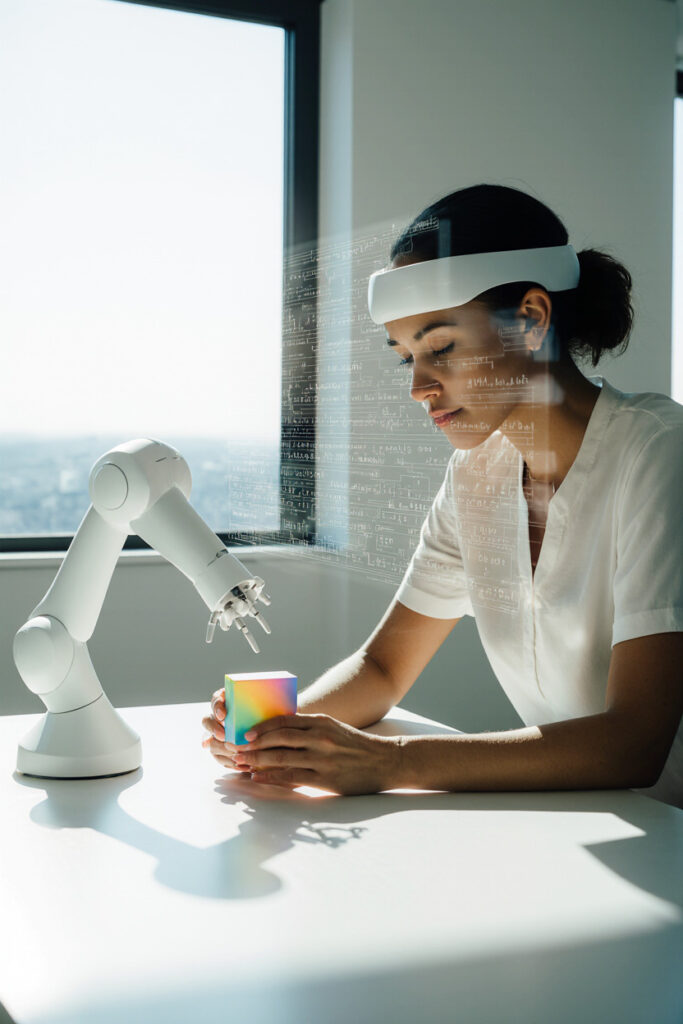
UCLA engineers built a non-invasive brain–computer interface that pairs a standard EEG cap with a camera-based AI “co-pilot.” In trials, participants—including one paralyzed user—completed tasks like cursor control and block relocation far faster with the AI aide, and the setup approached the performance of invasive systems without surgical risks. Published in Nature Machine Intelligence, the work hints at near-term BCI utility for wheelchairs, smart homes, and communication aids. This is one of those “quiet” breakthroughs that, in retrospect, will look loud. samueli.ucla.eduNeuroscience News
MIT, meanwhile, is pushing public health into the same “AI-assisted” future. Its VaxSeer system analyzes decades of viral sequences and lab data to pick flu strains—reportedly besting WHO selections in 15 of 20 historical seasons across two major lineages. If it holds prospectively, fewer bad flu seasons is exactly the kind of “boring win” we want from AI. (From the newsletters.)
7) Culture, Tools, and the Everyday “AI-ification” of Work
The seep-in effect
Florida State University researchers found that words favored by LLMs (“delve,” “meticulous,” “boast,” etc.) are showing up more in unscripted podcasts since ChatGPT launched. That’s not language snobbery; it’s a signal. As creators and professionals co-write with models, the machines’ fingerprints creep into our speech patterns, slide decks, and code. The upside: shared patterns can reduce friction. The risk: sameness. (From the newsletters.)
Practical toys that aren’t toys
- Figma AI can now turn a text prompt into an interactive mobile app mock with sensible spacing, states, and even auth/database suggestions. Designers keep control; juniors become amplified.
- Wispr Flow lets you create voice-triggered text snippets (“intro email”) that paste multi-sentence templates anywhere you type. Five minutes to set up, hours saved each week.
- Yutori Scouts are agentic web monitors: describe what to watch, and they ping you when it changes. Hook them to restocks, filings, or grant portals.
- Video agents like Popcorn now stitch coherent 1–3 minute narratives—dialogue, lip-sync, SFX—from a single prompt. It’s early, but the “one prompt → finished artifact” wave is spreading.
(All summarized from the newsletters.)
8) The Macro Arc: Who Pays, Who Polices, Who Wins?
Put the pieces together and three themes dominate.
A. Provenance and policy are no longer back-office issues
Anthropic’s settlement doesn’t touch the abstract legality of training on copyrighted text; it punishes piracy. Apple’s suit extends the same logic. Meanwhile, Brussels is reaching into Google’s ad plumbing with force. Whether you’re an AI lab or an ad giant, the cost of doing business will now include audits, provenance pipelines, and structural separation where conflicts persist. AP News+1Reuters
B. The compute land grab favors vertical integrators
OpenAI’s five-year burn projection and Broadcom tie-up are two sides of the same coin: frontier AI is a capital market, not just a product market. Whoever controls supply (chips), capacity (data centers), and costs (custom silicon) wins the right to iterate. Nvidia’s still the king, but ASICs and policy are rearranging the board. ReutersFinancial Times
C. Robotics is crossing the threshold from demo to deployment
Airport approvals, humanoid dishwashing, undersea inspections—the “where will robots start?” question increasingly has answers. The first wins won’t look like sci-fi: they’ll be tedious, regulated, and economically irresistible.
9) Quick Hits You Might Have Missed
- Broadcom’s quarter reinforced why networking and custom silicon are the other pillars of AI infrastructure. The stock popped to new highs on the $10B mystery order chatter—again, widely attributed to OpenAI. Barron’s
- Waymo is also expanding testing in harsher climates like Seattle and Denver—important for a service that can’t be “sunny-day only.” (From the newsletters.)
- Salesforce said AI agents let it cut support headcount by 45% this year—love it or hate it, that’s what enterprise “adoption” looks like. (From the newsletters.)
- ASML reportedly plans a strategic investment in Mistral, reinforcing Europe’s desire for AI sovereignty. (From the newsletters.)
10) What It Means for You (and What I’d Watch Next)
- For operators: Expect procurement and legal to assert more control over AI tools. Build provenance into your content pipelines now—what datasets, what licenses, what vendors. You’ll be asked.
- For builders: Consider the “honesty tax.” Products that reward models for calibrated uncertainty (and surface that to users) will win in healthcare, finance, and government. “I don’t know, but here are three vetted sources” beats an eloquent hallucination every time.
- For investors: Near-term volatility in semis is a feature, not a bug. Follow the picks-and-shovels: EDA + simulation (Cadence), networking + custom silicon (Broadcom), optical interconnects, and the boring stuff that lowers $/FLOP. ReutersBarron’s
- For policy folks: The EU’s Google decision and the U.S. debate over the GAIN AI Act are opening salvos in a longer contest over who sets the rules for compute, ads, and data. Expect more muscular remedies and—if history is a guide—more litigation. AP NewsReuters
- For everyone else: The coolest story this week wasn’t trillion-parameter anything; it was UCLA’s EEG cap helping a paralyzed person move a robotic arm without surgery. That’s the kind of progress voters understand and budgets defend. samueli.ucla.edu
Sources & Further Reading
- Cadence–Hexagon deal: Reuters, Hexagon PR. ReutersHexagon
- Waymo @ SJC airport: TechCrunch, SF Chronicle, SJC announcement. TechCrunchSan Francisco Chronicle
- Marvell selloff: Reuters, TipRanks recap. ReutersTipRanks
- Broadcom & OpenAI chips: Financial Times, Barron’s. Financial TimesBarron’s
- Qwen3-Max preview: VentureBeat/OpenRouter/launch comms. VenturebeatOpenRouter
- UCLA non-invasive BCI: UCLA Samueli press release; Nature Machine Intelligence coverage. samueli.ucla.eduNeuroscience News
- EU fines Google €2.95B: AP, European Commission press room. AP NewsEuropean Commission
- Anthropic $1.5B settlement: AP, LA Times analysis. AP NewsLos Angeles Times
- Apple OpenELM lawsuit: Reuters, 9to5Mac. Reuters9to5Mac
- Nvidia vs. GAIN AI Act: Reuters, Tom’s Hardware. ReutersTom’s Hardware
- OpenAI $115B burn: Reuters citing The Information; Bloomberg. ReutersBloomberg.com
Final Word
In three days we saw: a chip stock crater on timing noise, a software company become an engineering giant, a robotaxi clear the TSA-adjacent hurdle, the EU tell Google to break its own habits, authors get paid, Apple get sued, OpenAI prepare to spend like a country, and researchers suggest the most human fix to AI’s most annoying flaw.
That’s not chaos—it’s a pattern. Compute is consolidating; law is catching up; robots are leaving the lab; and the best AI may soon be the one that admits uncertainty when the stakes are high. The next few months will test who can execute under those rules.
If there’s one thing to “delve” into (sorry, FSU linguists), it’s the boring infrastructure and governance layers—because that’s where the durable value (and the real moats) are forming.