A Garden Mystery Solved
Imagine this: it’s spring, and your fruit tree bursts into bloom, each branch covered in delicate blossoms. You imagine the baskets of fruit you’ll be picking come fall. But months later, the harvest is small — maybe even nonexistent. The leaves are green, the tree looks healthy, so what went wrong?
The answer, for many gardeners, is pollination. Without it, flowers remain just that — flowers — and never become the fruit you’ve been waiting for. Understanding the science of pollination not only solves the mystery, but also gives you the power to dramatically increase your harvests.
The Science of Pollination: From Flower to Fruit
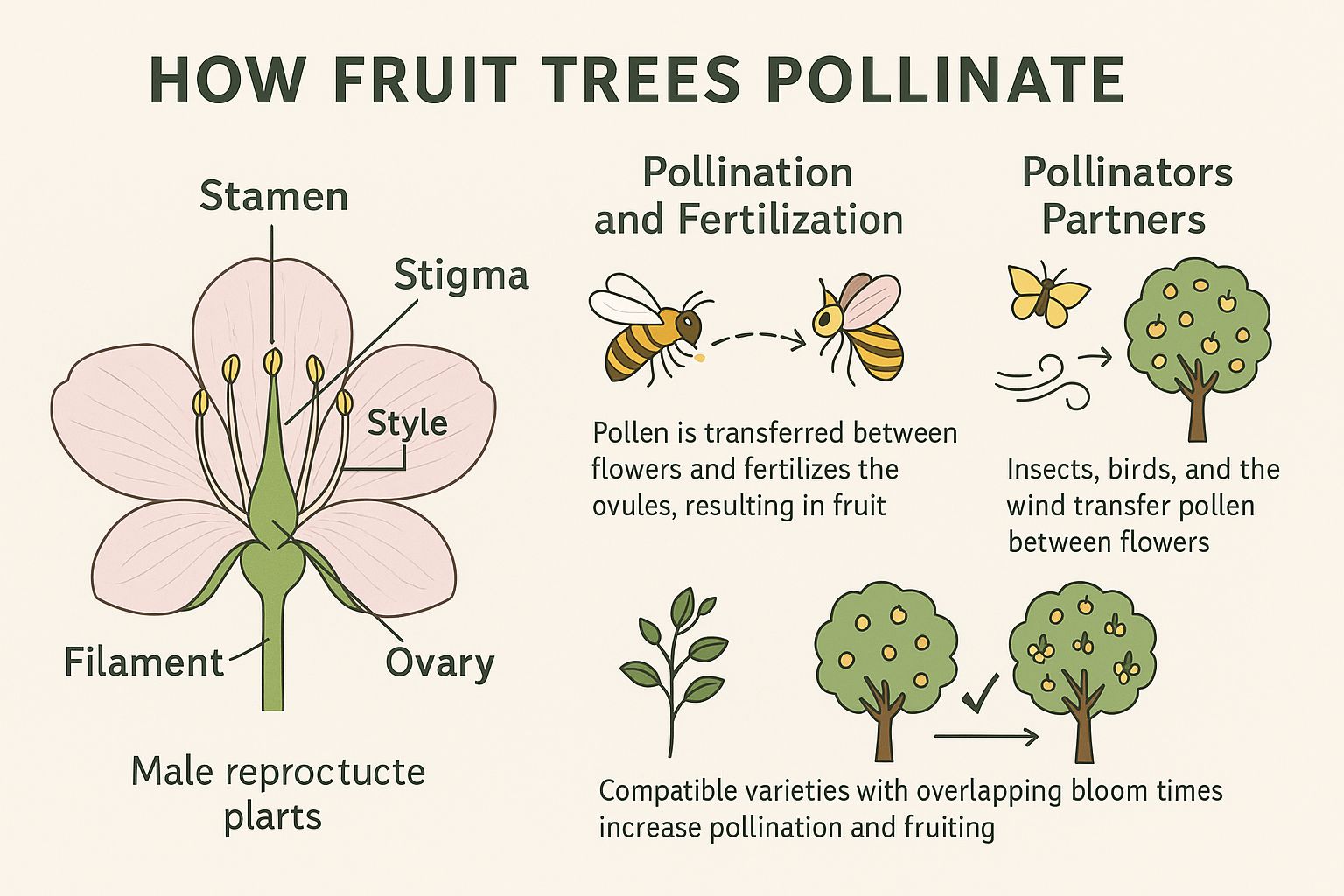
At the heart of every fruit tree is a reproductive system that relies on the movement of pollen. Each flower has two main reproductive parts:
- The stamen, which produces pollen in the anther — this is the male part of the flower.
- The pistil, with its sticky stigma at the tip, which leads down the style to the ovary where seeds will form — this is the female part.
When pollen grains land on a stigma, they germinate, sending out a tiny pollen tube down the style toward the ovary. Inside that tube, sperm cells travel to fertilize the ovules. Once fertilized, the ovules develop into seeds, and the surrounding tissue begins to grow into fruit. This entire process hinges on one thing: getting the right pollen to the right flower at the right time.
Self-Pollination, Partial Self-Pollination, and Cross-Pollination
Some fruit trees can transfer pollen from their own flowers to their own stigmas — this is self-pollination. The genetic material is the same, but fertilization can still occur. Many peaches, nectarines, and apricots fall into this category. They can produce fruit without a partner, though yields often improve when pollinators visit frequently.
Partially self-pollinating trees occupy a middle ground. They can set some fruit on their own, but their full potential is only reached when another compatible tree’s pollen is available. Sweet cherries like ‘Stella’ and certain plums often behave this way.
Then there are cross-pollinating trees, which absolutely require pollen from a different variety of the same species to bear fruit. This pollen must come from a tree that blooms at roughly the same time and produces compatible pollen. Apples, European pears, and many cherries depend entirely on this partnership. Without it, flowers may bloom beautifully but remain unfertilized.
What Makes a Good Cross-Pollinator?
Compatibility is more than just species. A good cross-pollinator must be in bloom simultaneously with your main tree so that pollen is available when stigmas are receptive. Bloom periods that miss each other by even a week can drastically reduce success. Pollen compatibility also matters — some varieties produce sterile pollen and can’t fertilize others.
Take the example of a ‘Honeycrisp’ apple. Pairing it with a ‘Fuji’ or ‘Granny Smith’ works well because their flowers open in the same window, and their pollen is fertile. Planting it near a crabapple can also work — crabapples are famously good pollinators for orchard apples because of their abundant blooms and overlapping flowering times.
The Role of Pollinators in Nature’s Assembly Line
While some pollen moves by wind, most fruit trees rely on animals — especially insects — to move it from flower to flower. Bees are the primary workforce here, not because they are the only pollinators, but because they are incredibly efficient. A single honeybee can visit 50 to 100 flowers on one trip, collecting nectar and pollen to bring back to the hive, and in doing so, dusting each stigma it brushes against with grains from the last flower it visited.
Other pollinators — bumblebees, mason bees, butterflies, hoverflies, and even some birds like hummingbirds — also play vital roles. These creatures don’t just increase the number of pollinated flowers; they improve the quality of the fruit. More pollen on a stigma means more ovules fertilized, which often results in larger, more symmetrical fruit.
Even self-pollinating trees benefit from pollinators. While their flowers can fertilize themselves, pollinator visits spread pollen more evenly and encourage fertilization of more ovules, leading to fuller fruit.
Why More Trees Means More Fruit
If your yard has only one apple tree and it’s a cross-pollinating variety, you’re relying on compatible trees in nearby yards and on pollinators willing to travel between them. By planting a second compatible variety within about 50 feet, you dramatically increase the availability of pollen and the likelihood that pollinators will transfer it between the trees.
Even in self-pollinating species, more flowers in the area attract more pollinators. When pollinators have a feast of blooms to work through, they spend more time in your yard, increasing the odds that every flower gets its share of pollen. The result is not just more fruit, but often fruit that’s better shaped, larger, and more consistent in quality.
The Hidden Barriers to Successful Pollination
Several factors can quietly undermine pollination:
- Timing mismatches between bloom periods of two trees.
- Poor weather during bloom — rain, cold, and strong wind can keep pollinators away or damage blossoms.
- Lack of pollinator habitat, which reduces the number of visits.
- Planting sterile varieties without realizing they can’t act as pollinators.
Addressing these often means adding diversity to your planting, creating shelter and food for pollinators, and making sure bloom times align when selecting new trees.
Hand-Pollination: Giving Nature a Nudge
In small gardens or in years when pollinator activity is low, hand-pollination can be surprisingly effective. Using a small paintbrush, you can transfer pollen directly from the anthers of one flower to the stigma of another. The best time to do this is on dry mornings when flowers are fully open and pollen is loose. This is especially useful in greenhouses or for trees that bloom during poor weather spells.
Pollination in Tight Spaces
Not everyone has room for two full-sized trees. Solutions include planting multi-graft trees with several compatible varieties on one rootstock, using espalier techniques to train trees along a wall, or keeping small trees in pots and moving them close together during bloom. Even a crabapple in a decorative planter can serve as a pollinator powerhouse for apples.
Determinate vs. Indeterminate: A Side Note for the Food Gardener
While not a pollination term, “determinate” and “indeterminate” describe growth and fruiting patterns. Determinate plants reach a set size, flower, and fruit within a short period, then stop. Indeterminate plants keep growing and producing over a long season until frost ends their cycle. Knowing which type you’re planting helps you plan for whether your harvest comes in a single glut or in steady trickles — and this applies not just to vegetables like tomatoes, but to some small fruiting plants and berry bushes as well.
Troubleshooting Pollination Failures
When flowers open but fruit never sets, first look at pollination. Are there compatible varieties nearby? Were pollinators active during bloom? Did weather interrupt? Sometimes, the solution is as simple as planting a second variety, adding pollinator-friendly flowers, or shielding blossoms from heavy rain.
Misshapen or small fruit often indicates partial fertilization — some ovules developed while others did not. In these cases, boosting pollinator visits or hand-pollinating during bloom can make a noticeable difference the following year.
The Bigger Picture: Pollination as Partnership
Pollination is not just a mechanical process; it’s a complex relationship between plants, pollinators, and the gardener. Each plays a part: the tree produces flowers timed to attract pollinators, pollinators move pollen as they forage, and gardeners set the stage by planting compatible partners and supporting the insects that do the work.
Understanding this connection means your orchard — whether it’s two trees or twenty — can reach its full potential. Instead of a handful of fruit, you could be picking baskets, with enough left over to share with neighbors.